Docebo: A Complete Guide for SaaS Professionals
Docebo
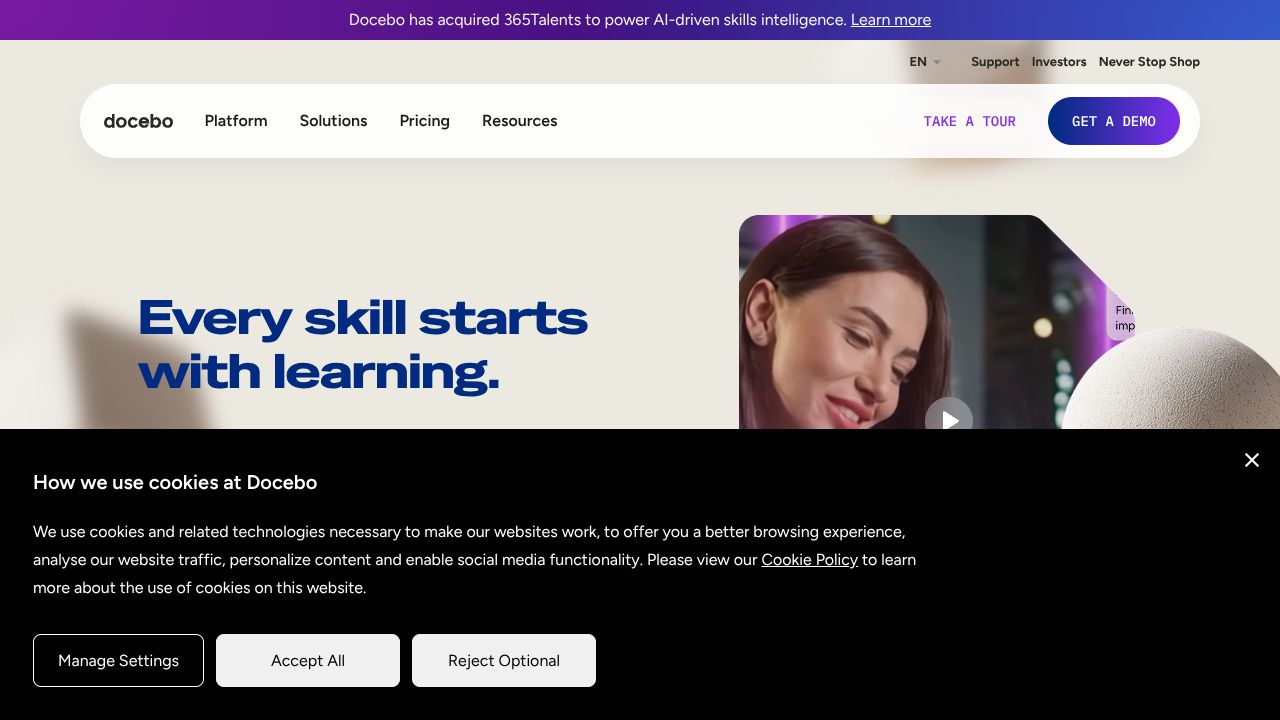
Docebo is a workplace learning platform with AI-driven content curation, virtual coaching, and personalized paths, building communities around structured training and real-time guidance.
Your LMS is a cost center. Docebo can turn it into a performance engine.
Most corporate learning stacks are compliance checkbox machines that don’t move the needle on performance. Docebo (https://www.docebo.com) matters because its AI-driven curation and real-time virtual coach shift learning from “catalog consumption” to “in-the-moment enablement.” Bottom line: if your revenue, support, or partner teams need faster time-to-competency and fewer tribal-knowledge bottlenecks, Docebo is one of the few enterprise LMS options positioned to deliver measurable impact.
The Business Case
In my 15 years, the only learning platforms that earn executive love are the ones that compress time-to-value in frontline roles. Docebo’s AI curation and virtual coaching reduce the lag between “I need to know” and “I can do,” which is where enablement ROI lives. Expect value not from bigger content libraries, but from fewer escalations, shorter sales ramp, higher partner certification throughput, and lower support handle times—provided you wire Docebo to your live knowledge sources and workflows.
Competitive edge comes from personalization and community: cohort paths, expert-generated microcontent, and an AI coach that guides users in real time. That’s a step beyond legacy LMS static modules. Market-wise, Docebo sits between heavyweights like Cornerstone and HCM-native offerings, giving you modern AI capabilities without ripping and replacing your HR core. Hype check: AI curation alone won’t save you; governance, metadata discipline, and integration depth will. If you invest there, Docebo can shift learning from sunk cost to performance lever.
Key Strategic Benefits
- >
Operational Efficiency:
Docebo’s AI cuts manual curation time by surfacing relevant content based on role and behavior, freeing L&D teams from constant catalog maintenance. The virtual coach reduces “shoulder taps” and Slack pings by answering routine questions in the flow of work. - >
Cost Impact:
You’ll curb spending on instructor-led retraining by driving on-demand, contextual refreshers. On the revenue side, tighter paths for sales and partners can shorten ramp and expand certified partner capacity—two levers with direct P&L implications. - >
Scalability:
Built for multi-audience learning (employees, customers, partners) with robust integrations into HRIS, CRM, and support systems, it scales as you add products, regions, and go-to-market motions. Personalization engines handle content explosion more gracefully than rule-based catalogs. - >
Risk Factors:
The AI coach is only as good as your knowledge base—garbage in, guidance out. Watch for content sprawl, hallucinations without guardrails, and rising costs under custom pricing as monthly active learners grow. Strong governance and prompt/content design are non-negotiable.
Implementation Considerations
Plan for an 8–16 week phased rollout: 1) foundational integrations and SSO (Okta/Azure AD), 2) role-based paths for 1–2 priority personas (e.g., SDRs and Tier-1 support), 3) AI coach pilot with a curated, vetted knowledge set, 4) analytics instrumentation and iteration. Resource-wise, you’ll need L&D ops, a knowledge architect, a business owner per function, and IT for integrations (HRIS, CRM like Salesforce, and ticketing like Zendesk).
Change management is the differentiator. Seed community with trusted SMEs, set clear “use the coach first” norms, and retire redundant content/tools to avoid confusion. Define business KPIs up front (e.g., weeks to first deal, time-to-close for support, partner certification pass rates) and baseline them before go-live. Security and compliance: validate data residency options and review AI data handling, access controls, and audit trails to meet GDPR/SOC standards. Treat prompt design and content tagging as ongoing disciplines, not a one-off project.
Competitive Landscape
If you need deep compliance and breadth across HR workflows, Cornerstone OnDemand (https://www.cornerstoneondemand.com) remains the enterprise incumbent; see the Fosway 9-Grid for Learning Systems (https://www.fosway.com/9-grid/learning-systems/) for market positioning. Workday Learning (https://www.workday.com) is attractive for HCM-native shops but tends to lag in external/partner training depth and AI coaching. 360Learning (https://360learning.com) excels in collaborative, peer-led learning; strong for “learning by shipping,” weaker on AI coaching depth. Degreed (https://www.degreed.com) shines as an LXP and content aggregator but typically requires an LMS backbone for formal training.
For peer benchmarks, review the G2 Grid for LMS (https://www.g2.com/categories/learning-management-systems-lms) and Training Industry’s LMS watchlists (https://trainingindustry.com/top-training-companies/learning-management-systems/). Docebo’s differentiation is the real-time virtual coach layered on enterprise-grade LMS—positioning it beyond static content hubs without forcing a full HCM stack commitment.
Recommendation
- >Greenlight a 90-day pilot focused on one revenue-critical use case (e.g., SDR ramp or Tier-1 deflection).
- >Integrate Docebo with your CRM/support system and a vetted knowledge base before piloting the AI coach.
- >Set 3 outcome KPIs (e.g., ramp time, time-to-first-response accuracy, partner pass rate) and instrument baselines.
- >Stand up a content governance board and retire duplicate tools to drive adoption.
- >If pilot hits target deltas, negotiate MAU-based pricing with guardrails and scale to partners/customers next.
Overrated: “AI curation will fix engagement.” Underrated: “Real-time coaching + clean knowledge reduces time-to-competency.”