Lorikeet Security vs Flowtriq: Head-to-Head Breakdown
Lorikeet Security
Lorikeet Security offers a comprehensive offensive security platform for vulnerability management, penetration testing, and compliance automation.
Most pentests give you a PDF — Lorikeet gives you a program
Most security vendors hand you a PDF and a date on the calendar. That’s fine if you want a one-off checkbox. In my 15 years watching SaaS security mature, I’ve learned the real wins come from continuous discovery, human-verified findings, and tooling that integrates into product and compliance lifecycles. Lorikeet Security isn’t just a “pentest” vendor — it’s a platform that pairs manual offensive testing with 24/7 attack surface monitoring, compliance automation, and an AI assistant to speed remediation. While niche tools solve specific problems (more on that below), Lorikeet builds a continuous security program you can operate.
Step 1: Getting your Lorikeet workspace live
- >Sign up and request an onboarding — Lorikeet engagements are consultative, so expect a short intake call to scope targets (web apps, APIs, cloud, AD, etc.). In my experience that upfront effort saves weeks later.
- >Create your team portal — you’ll get a real-time portal where you can invite engineers, product owners, and auditors. Grant the minimum necessary roles.
- >Add assets and define scope — list domains, app endpoints (REST/GraphQL/SOAP), cloud accounts (AWS/Azure/GCP), and internal ranges. For cloud, create a read-only role or scoped API key as recommended.
- >Schedule your first engagement and monitoring — choose the type: full pentest, red team, or continuous attack surface monitoring. Confirm whether you need social engineering, physical testing, or IoT work so Lorikeet schedules appropriately.
- >Connect compliance integrations — if you use Vanta or Drata, link them during onboarding to start building audit-ready artifacts.
Step 2: Core features you’ll use every week
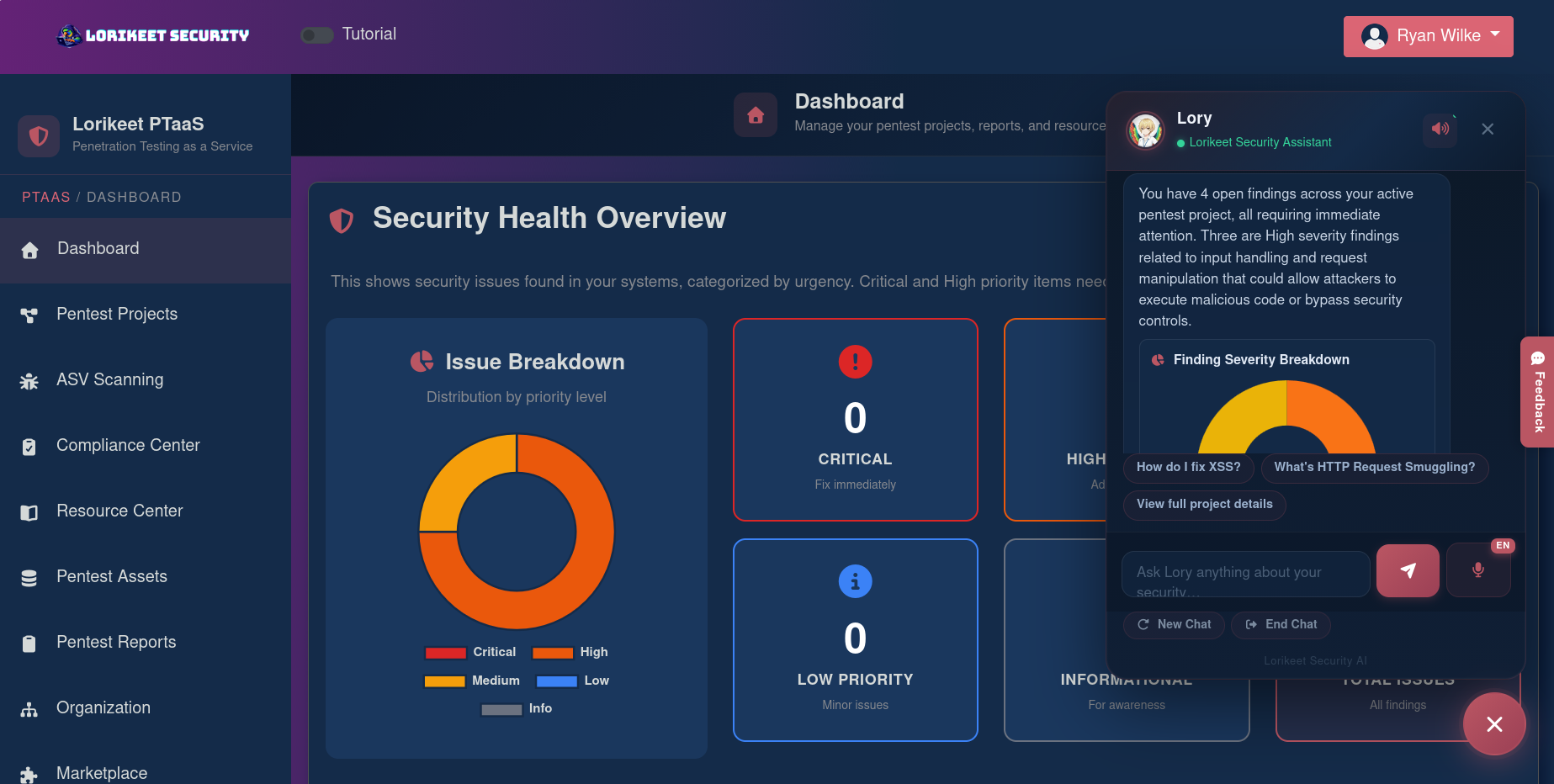
- >Real-time engagement portal + Lory (AI assistant) — watch tests run live, triage findings with Lory’s initial context (trained on ~2,000 vulnerability entries), then assign tickets to devs. Use Lory to draft remediation steps that developers can action.
- >Manual penetration testing across the stack — request specific coverage: APIs, mobile, containers, AD, Kubernetes. Lorikeet’s emphasis on human testing reduces false positives and gives reproducible exploit paths.
- >Continuous attack surface monitoring — this 24/7 feed finds new exposures (forgotten subdomains, misconfigured S3 buckets, exposed APIs) so you’re not surprised between scheduled pentests.
- >Compliance automation and audit-ready reporting — map findings to SOC 2, PCI, ISO 27001, GDPR, etc., and export evidence for auditors. Lorikeet partners with attestation firms so you can go from pentest to certified audit.
- >Free retesting and remediation guidance — after fixes, use included retesting to validate fixes without extra negotiation. Remediation write-ups are written both for engineers and auditors.
Step 3: Pro moves SaaS teams use to move faster
- >Test staging first, then production — reduce blast radius and get rapid fixes in staging before production validation.
- >Integrate findings into your ticketing and CI/CD — push issues to Jira/GitHub and gate releases with fixes for critical findings.
- >Use retesting to close the loop — schedule retests as soon as fixes are merged; free retests remove the usual friction with pentest vendors.
- >Align pentest scope with compliance goals — tell Lorikeet which framework you’re targeting (SOC2/PCI/etc.) so findings map to audit controls.
- >Run Parrot CTFs for dev teams — practical, gamified learning accelerates remediation maturity and reduces repeat findings.
Common mistakes teams make (and how to avoid them)
- >Mistake: Scoping only external endpoints. Fix: Include internal ranges and cloud projects—most SaaS breaches start with misconfigured cloud assets.
- >Mistake: Treating the report as a checkbox. Fix: Create SLAs for remediation and use the portal to track progress and retests.
- >Mistake: Giving vendors full production admin access. Fix: Use least-privilege roles and scoped read-only integrations; Lorikeet’s onboarding supports this.
How it compares to other tools in the stack
While Flowtriq excels at instant DDoS detection and automated mitigation to keep servers online, Lorikeet Security is better suited for comprehensive offensive testing, compliance-ready audits, and continuous discovery across web apps, APIs, and cloud infrastructure. Flowtriq may be simpler to deploy and focused on uptime protection; Lorikeet is broader, platform-driven, and built for organizations that need human-verified findings and end-to-end audit evidence.
Conclusion: Who should buy Lorikeet (and who shouldn’t)
From what I’ve seen, Lorikeet is ideal for SaaS teams that want more than a one-off pentest: companies that need continuous attack surface visibility, manual validation, compliance automation, and developer-friendly remediation workflows. If your priority is automated DDoS mitigation only, a specialist like Flowtriq might be more cost-effective. What others won’t tell you: paying for human expertise up front often saves far more in developer time and false-positive cleanup later — and Lorikeet’s platform model keeps security operational, not ceremonial. If you want security that integrates with product lifecycles and audits, Lorikeet deserves a pilot.